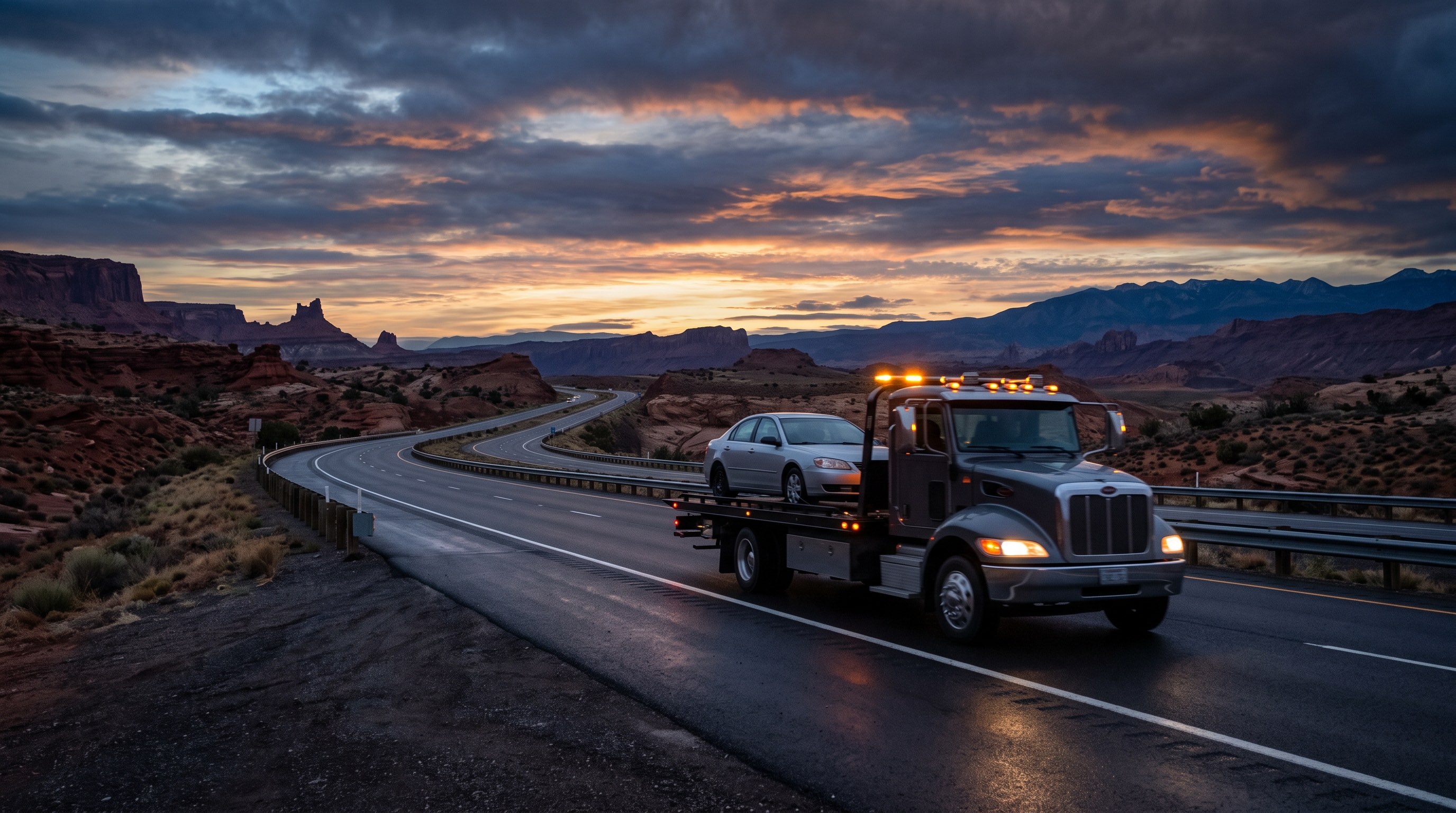
Not every tow is a short hop. Sometimes the car has to go a long way — over the pass to a dealer or specialty shop in the Salt Lake Valley, or across the county to a repair yard — and sometimes you're dealing with an impound and just trying to find out where your vehicle went. This guide covers how long-distance towing is priced, how impounds actually work in Tooele County, what it costs, and how to vet an operator. We're an independent dispatch-connection service, and one call to (435) 272-1946 helps you request availability from an independent local operator for the tows you arrange yourself.
Long-distance towing: what actually matters
For a long tow, the truck choice matters even more than it does around town. Miles add up, and the wrong setup adds wear or damage the whole way.
- Flatbed is the standard for distance. The vehicle rides fully off the ground, so there's no drivetrain wear, no dragging, and nothing to fail over 40 or 80 miles. It's the right call for AWD and 4WD vehicles, low or damaged cars, and anything valuable.
- Wheel-lift can work for short-to-medium hops of a drivable front- or rear-wheel-drive car, but for a real long haul most operators and most vehicles are better on a flatbed.
The other thing that matters is doing it in one trip with a clear price. A long tow should be quoted as a base fee plus a per-mile rate before the truck rolls, so there's no surprise at the far end — and no meter running in your head the whole way over the pass.
| Factor | Flatbed | Wheel-lift |
|---|---|---|
| Long-distance wear | None — off the ground | Adds wear over miles |
| AWD / 4WD / low cars | Safe | Risk of damage |
| Best role | Long hauls, valuable or damaged | Short drivable tows |
Why long hauls are normal out here
Tooele County's geography makes long-distance tows routine rather than rare. The county is big and mostly rural, and most dealerships, specialty mechanics, transmission shops, and body shops are over in the Salt Lake Valley — which means a breakdown in Tooele, Grantsville, or Stansbury Park often ends with a haul east over the point of the mountain rather than a quick trip across town. It's simply where the vehicle needs to go.
Distance runs the other way too. The I-80 corridor stretches west across the Great Salt Lake Desert to Wendover and the Nevada line, so a breakdown out on the salt flats can mean a long tow back toward Tooele or the valley, and travelers crossing the state sometimes need a vehicle moved a serious distance. Add in people relocating, buying a car out of the area, or moving a non-running project vehicle, and long-distance towing is a steady part of life in this county.
The key on any of these is a flatbed, a per-mile price agreed up front, and an operator who runs these routes and won't be surprised by the mileage. A long haul quoted honestly before you commit is a very different thing from one where the number only appears at the destination.
How impounds work in Tooele County (an honest note)
This is the part worth being straight about, because it's widely misunderstood: a police-ordered impound is assigned by Tooele County dispatch, not chosen by the driver. When law enforcement has a vehicle towed — after a crash, an arrest, an abandoned-vehicle call, or a violation — the county calls whichever tow company is next up on the rotation. You don't pick the company, and neither do we. As an independent connection service, we can't release a vehicle that another company was ordered to impound. What we honestly can do is help with the tows you arrange yourself — owner-requested long-distance tows, and private-property tows a property owner requests.
If your vehicle has been impounded, here's the realistic path to getting it back:
- Call Tooele County dispatch or the sheriff's office to find out which company was assigned and where your vehicle is being stored.
- Confirm what you'll need to release it — typically your photo ID, the vehicle registration, and proof of insurance, and in some cases a release from the agency that ordered the tow.
- Ask about the fees — the tow charge plus daily storage, which are set by the assigned company under Utah's regulated schedule for nonconsensual tows, not by us.
- Act quickly, because storage fees accrue for every day the vehicle sits in the yard.
- Bring payment in the form the yard accepts, since some take only cash or specific methods.
None of that runs through us on a police impound — but if you're arranging your own tow, or a property owner needs a vehicle removed, that's exactly the kind of work we can connect you with.
What does long-distance and impound towing cost in Tooele?
Long-distance tows are priced as a base (hook) fee plus a per-mile rate, so the total tracks the distance and the truck. Impound costs are a different animal — a tow charge plus daily storage, set by the assigned company under state rules.
| Service | Typical range* |
|---|---|
| Base / hook fee | $65 – $150 |
| Per-mile (long-distance) | $3 – $6 per mile |
| Tooele to Salt Lake Valley | Base + per-mile, quoted |
| Impound release (tow charge) | Set by assigned company |
| Daily storage | Often $25 – $60 per day |
*Ballpark ranges, not a quote. Utah caps maximum fees for nonconsensual (police-ordered) tows and storage under a state schedule, so impound figures are set by the assigned company and the regulator — not by this service. For an owner-requested long-distance tow, the only number that applies is the operator's quote for your vehicle and route.
If you carry an auto-club membership, it's worth checking the included towing distance before counting on it — plans like AAA cover towing only up to a set number of miles, and long hauls out here often run past that limit. For a tow you're arranging yourself, the honest way to get a real number is to give an operator your vehicle, your location, and the destination and ask for the base fee and per-mile rate together — which is exactly what happens when you call (435) 272-1946.
How to vet any long-distance or impound tow operator (including us)
Whether it's a long haul you're booking or an impound you're untangling, these questions keep you out of trouble:
- For a long tow, is it a flatbed, and what's the base fee plus per-mile rate to my destination?
- Will the price hold, or could it change once we're on the road?
- Are you licensed and insured for a long-distance haul?
- For an impound, who actually has my vehicle — and can you confirm you're not just charging me to look?
- What paperwork and payment will I need before I show up?
A straight operator gives you a clear per-mile number for a tow you book, and tells you plainly that a police impound goes through county dispatch — not a runaround. Anyone who claims they can spring your impounded car from another company's yard for a fee is not being honest with you.
Long-distance & impound questions, answered
My car was impounded by police — can you get it out?
No, and here's the honest reason: police-ordered impounds are assigned by Tooele County dispatch to whichever company is up on the rotation, not chosen by the driver — and no independent service can release a vehicle another company was ordered to impound. Call county dispatch or the sheriff's office to learn which yard has it. We can help with tows you arrange yourself and with private-property removals.
How do I find out where my impounded car is?
Start with Tooele County dispatch or the sheriff's office; they can tell you which company was assigned and where the vehicle is stored. Bring your photo ID, registration, and proof of insurance to release it, and be ready for a tow charge plus daily storage. Act quickly, because storage fees add up every day the car sits.
How much does a long-distance tow cost?
A long tow is typically a base (hook) fee plus a per-mile rate, often in the $3 to $6 per-mile range, so the total depends on the distance and the truck. Those are ballpark figures, not a guarantee — the honest way to get a real number is to give an operator your vehicle, location, and destination and ask for the base fee and per-mile rate together.
Can you tow my car to a shop in Salt Lake City?
Yes — hauls over the pass into the Salt Lake Valley are one of the most common long-distance tows out of Tooele County, since that's where most dealers and specialty shops are. It's a flatbed job, quoted as a base fee plus per-mile to your exact destination. Tell us the shop or dealer and where the car is, and you'll get a straight price before it rolls.
Do you do private-property tows?
Yes, at the request of the property owner or their authorized agent, following the applicable rules and signage requirements. To be clear, a private-property tow is something the property owner arranges — it isn't a service a random person can order against someone else's vehicle, and a legitimate operator will confirm the request is proper before towing.
Do you serve the whole county and beyond?
Yes — operators cover all of Tooele County, the I-80 corridor west toward Wendover, and long hauls east into the Salt Lake Valley. If what you actually need is a quick fix on the shoulder rather than a haul, our roadside assistance guide covers jump-starts, lockouts, flats, and fuel.